Fort Retreat

My best friend and I were having a drink in his room last night, when said he had a surprise for me. I smiled and asked to see it. He pointed under his bed.

His bed is really two beds, pushed parallel to the wall. A blanket falls over the mattress’s long side, hanging inches from the floor. I pulled the blanket up to peak beneath it. All I could see were his cardboard storage boxes, and darkness.

“What is this?” I asked. “Narnia?”

“Maybe,” he said. “Go see.” He pointed to a narrow gap between the boxes. Dropping to my hands and knees, I looked under the bed again. Through that tunnel of darkness, I could now make out a soft glow. And I began to crawl through, flattening my body and dragging myself along with my elbows.

The fort’s gray shag carpet was a welcome refugee for my elbows. Once inside, I felt suddenly alone. Blankets cascaded down as curtains, swaddling me in semi-darkness. Fairy-lights were strung up and down the back wall, tracing a mountain range of three-foot peaks. Their blue pricks of light splashed shadows everywhere. A tapestry hung above my hunched neck, buffering the bed’s ribcage.

It was cramped and it was wonderful. I marveled at the boy’s ingenuity.

“It’s a safe place,” he shrugged, after crawling in after me. Funny, how we seek refuge from our own rooms.


In the fort, the boy and I lay down on our backs, knees bent in front of us. Music floated down from above––we had left the speaker on his bed––and it sounded distant, as if we really had traveled far away.

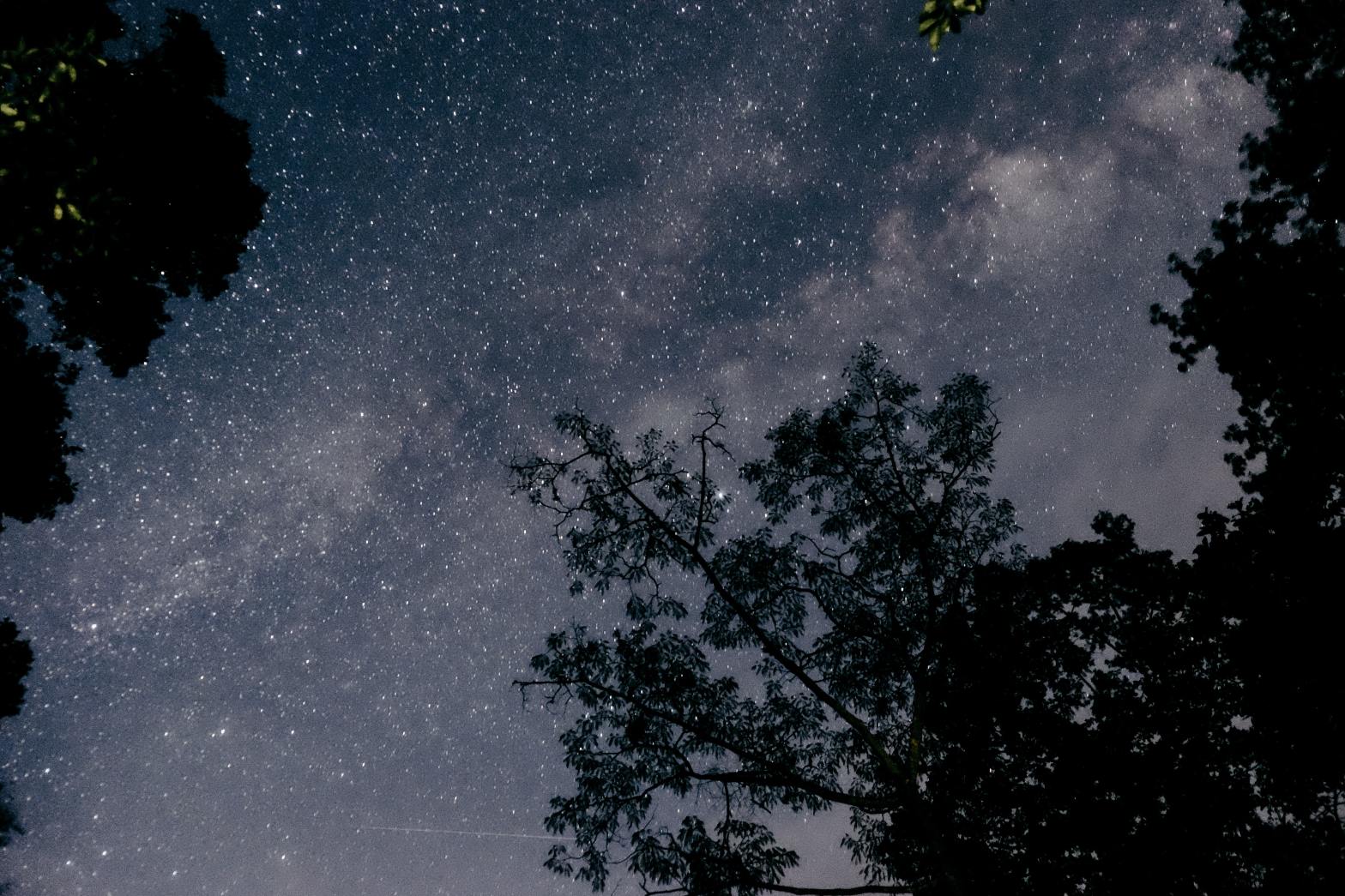
For most of the night, I gazed at the tapestry hanging above our heads. A starry sky was painted into the fabric, constellations framed by the dark silhouettes of treetops. It was easy to pretend this was our real view––as if we were really out in the natural world, peering up through the flaps of a tent. I could practically hear wind murmuring through the branches above. I could taste the cold air on my lips. I could smell the breath of our dying fire. I could feel the awe unfolding in my chest, an appreciation for bigger things.

Laying under those stars, he and I discussed apocalypses. Not the global pandemic. The apocalypse we imagine is more visceral than a virus: it involves running out into the world, not retreating from it. Our imagined disaster pushes us into the forest, where we must live in the moment, our eyes glued to the horizon, our ears tuned to the arrival of a faceless enemy. I think we long for a test that is raw and unmediated, to feel the harshness of the wild, the clarity of eating and killing and growing stronger. We wonder about our survival skills, our grit, our humanity. Most of all, we’re curious about our relationships: Who would live; who would die. Who would die for the others to live.

Would you die for me?

Yes, of course.

But in reality, we probably wouldn’t be given the choice. When it comes to mortality, there is no bargaining. If I could trade my life for someone else’s, I would have died twice already.


By the end of the night, conversation drifted to our respective childhoods. The bits of us that exist only through retellings. “What was the hardest part?” I asked him. “About growing up.”

“Moving,” he said. “Like, the actual packing and unpacking. My sister and I had to do it so many times, starting so young. Putting things in boxes and wrapping cups, and plates, and stuff––” he drifted off.

I imagined a young boy sitting cross-legged on the floor, folding kitchenware into newspaper. Carefully preparing items for another journey. With each move, he’d transfer his house into a dozen cardboard boxes.

In an apocalypse, his strength would be adaptability.

While the worst part of his childhood was moving, mine was the stillness. The year when nothing moved. For eight months, life was reduced to a ghostly desert tundra. I was in a snow globe, shaken up and then placed on a shelf. He knows about this year, but few people do. The sickness was a secret, after all. And I was in eighth grade, hardly a child. I wonder what he imagines I looked like back then. I’m glad he never had to see it.

In an apocalypse, my strength would be resilience.


Emerging from the fort felt like falling out of a wonderful dream: Disappointing. A sour taste returned to my mouth, left from the beer I drank before we went under. Saying goodnight to my friend, I left his dorm room and headed home.

I’d hoped the night air would be refreshing, but it was merely damp and forlorn. There was nothing inviting about it. I hugged myself as I walked, already wishing I were somewhere else: in the realm of fairy-lights and starry tapestry and shag carpet. In the place where apocalypses are fictional and we are the main characters, giving our lives for one another.

-mwp

The First Twenty-Four Things

Over the past mini-semester of January (at Colby, we call this “JanPlan”), I took a fiction writing course. In this course, I read collections from George Saunders, Raymond Carver, and Carmen Maria Machado, analyzing the style and substance of their stories. Class discussions were followed by writing assignments; I had to focus on specific elements of those stories, using them for inspiration.

The final project for this course…was to write a short fiction. I tried my best to do that. In some respects, I think I succeeded. And yet, I’m still editing, I’m still working on it.

My story, “The First Twenty-Four Things,” was submitted for a grade three days ago. However, I’ve got a long way to go before I’m satisfied with it.

I thought I’d post it here. If nothing else, as a sign that I’m still here, and I’m still writing.

First, a few disclaimers:

  • This story was inspired by Carmen Maria Machado’s story, “Inventory,” from her larger collection, Her Body and Other Parties. As an epidemic sweeps across the US, Machado’s narrator depicts her experience through various sexual encounters––creating a chronological list, or inventory, of bodies. I wanted to imitate this vignette-style, describing brief instances of intimacy which are spatially and temporally distant from one another. Although Machado writes about sex (with different people)––and I about love (for one person)––both of our stories are shadowed by illness and looming mortality. As a final nod to “Inventory,” my narrator keeps a list of everything she loved about her late husband. This list is presumably kept for their daughter to read when she’s older.

  • This story contains potentially triggering or sensitive material. Brain cancer, panic attacks, and childhood trauma are all included in the narrative.

  • The First Twenty-Four Things

    Matilda Weld Peck
               Our story was one of luck. 
               I got lucky; he got unlucky. This wasn’t the predictable fate for our respective characters, however. He was clearly the protagonist, the champion, the one to root for. And yet, the good fortune fell on me. 
    
    1.   How he used my name in a sentence
    2.   How he remembered everything I told him
     
               I met him in the Museum of Fine Arts, where I was a frequent visitor after finishing college. I appreciated the clean surfaces more than the art itself (a fact I never admitted, but I’m sure he eventually suspected). I admired the neat little labels and how the pieces were hung on the walls. A display of straight lines and sharp angles.
               But he loved the art. He loved how life could continue on a canvas for centuries after the painter had put down the brush. He wished he had been an art history major, I learned that afternoon. I was a business major, I told him, and I hoped to get an MBA someday. Most people are satisfied with a plan for “someday;” it sounds possible enough. But he wasn’t satisfied. I blushed when he asked about specifics, like he was already committed to the idea.
               But before all this––before I found the courage to cross the polished museum floor, stand beside him with my hands clasped together, and say “hi” in the softest voice that I knew he wouldn’t hear (What? he said, turning)––before our eyes fell into one another’s, I watched him. He was studying an oil painting: A pond filled with lily pads and koi fish. I wondered what could be so compelling about fish swimming between weeds. Time dragged its feet as we stood there, like chess pieces before the game. I noticed the shape of his back and the way he leaned slightly on one hip.
               I wanted him to turn around and see me. I never wanted him to turn around.
    
    3.   How laughter bubbled out of him, high and clear
    4.   How easily he became a child in those moments (or how quickly the adult layers fell away)
     
               On our sixth date, we walked through the Boston Common. It was an August evening, and I wore a sundress patterned with red and yellow flowers. He looked beautiful, and I wanted to tell him, but I didn’t want the world to hear. I wanted his beauty all to myself. Selfish, I know.
               The night breeze was soft and warm––like an invitation––and a giddiness had taken hold of me. I felt like a child on her birthday. When a child turns a new age, everyone asks: Do you feel different? and the answer is always no. But that night, the answer was yes, yes! My skin wanted his skin, my eyes couldn’t get their fill. As we walked through the park, fireflies blinked on and off, like silent paparazzi.
               We passed an old woman playing the violin, and he stopped and extended a hand. I shook my head shyly but took it anyway. I’ve never been graceful, but in his arms, it didn’t matter. He had enough grace for both of us. He spun me around and around, and I felt the air between my legs when my dress lifted. Later, I felt his mouth where the air had been.
    
    5.   How he liked to read Shakespeare before bed, especially aloud (afterwards, we’d analyze the characters together)
    6.   How he wasn’t scared of my nightmares
     
               One night, he asked about my childhood.
               I told him that, as a little girl, I imagined myself as a ball of string. Winding and unwinding. And I was never sure which was worse.
               Winding meant being good. It meant keeping my pieces tight and accounted for. I held them close to my skin––like tattoos that only I could see. And when the adults called me “quiet,” or “calm,” or even “sweet,” I knew I was doing OK.
               Unwinding meant the panic attacks, or so they came to be called. The invisible tattoos suddenly became an invisible net, forcing me to writhe and scream. My pieces went flying everywhere, staining floors and walls and making everything messy, messy, messy.
               I told him this. It was the first time I’d told anyone.
               He asked if I still felt this way, like a ball of string.
               I said: Sometimes, but not recently.
    
    7.   How he listened with his whole body
    8.   How his eyes combed through mine, as if searching for anything left unsaid
     
               After six months, we moved in together. My friends wondered if twenty-four was a little young? And if I was moving a little fast? And they were right. For the first time in my life, I was young, and I was moving fast. We picked an apartment with lots of windows.
               I adored the place when it was empty––washed clean with sunlight and the absence of habitation. The apartment felt like a new canvas, ready for the paint of our daily lives. But, as we began to settle in, my uneasiness grew. Like a ghost trailing behind me, whispering stories from a childhood long ago. And one evening, when he proudly declared: It’s finally looking like home! I nearly cringed. I didn’t trust that word, home. It had undertones of danger. 
               Home was where parents screamed at each other about money and the sound of smashing bottles vertebrates through the walls. Where a father passed out on the couch and slept until 11am, stinking up the room like a dying animal, and growling like a bear if awoken. Where a mother hosted friends when the father was out drinking––three different men, never at the same time. Where dinners were made in a microwave or purchased at the McDonald’s down the street. (Every kid wants to go to McDonald’s! the mother would say, as she pushed her daughter out the door. Get me a Diet Coke.) Home was where two sisters huddled together in a bedroom closet: making friendship bracelets after school or listening to music when the screaming got loud. And when the older sister left for college, home held no sanctuary. 
               That home doesn’t exist anymore. My parents are divorced, and they live in different cities. My sister is better at keeping in touch with them, but she doesn’t blame me for my silence. Yet still, I told him about this home, and how it haunts me. How returning to the same door, the same hallway, the same bed every night––it feels ominous. Like hatred could be brewing inside.
               That’s a terrible version of home, he said after a while. Can I share a different version?
               And so, he told me about a home where movie nights transpired, and cakes were baked on birthdays, and homework was done at the dining room table. Where three brothers had soccer tournaments in the backyard (and one brother, he claimed, always won), where a mom prepped sandwiches for school lunches, and where a dad made the best Saturday morning pancakes.  
               I said I liked his version better. 
               He said it would be mine, too. And even now, I still believe him. 
    
    9.   How his hair looked right after a shower
    10. How he always picked up flowers from the supermarket, even when the selection was bad, or the petals were dyed tacky colors 
     
               We had a big argument that March, when I told him I no longer wanted to enroll at Northeastern. Business school was too expensive, I said, I’d be paying off loans forever. And even if I could afford it, I wasn’t cut out for it. Anyway, my job as a marketing associate was good enough, and I’d get a promotion soon.
               He disagreed, saying I shouldn’t settle for a job I didn’t like. I found marketing boring, remember? I hated assessing customer satisfaction and making stupid spreadsheets that were never seen, remember?
               Yes, yes. I remembered. But it was just a temporary position and––
                Temporary until grad school! 
               But what if I changed my mind?
               You haven’t, he said. You’re just scared. And it’s silly to be scared, he added, because he would be there the whole time and he would–– 
               You’re not my good luck charm!
               We argued for a while, our voices getting louder and louder. He demanded why I was giving up so easily, why I was letting money and uncertainty get in the way of my ambition. He said it was time I fought for the life I wanted.
               He had no idea what he was talking about, I yelled. For me, existing was not some beautiful journey filled with beautiful opportunities and adventures. My path had not been paved by loving parents and good grades and a soccer scholarship to college––and I did not tread this path filled with natural charisma and a pocket full of good stories. I was not like him. I didn’t get to choose my battles, the way he did. 
               And then I ran to the bathroom and locked the door behind me.
               Forty minutes later, I heard his soft knock. He held me as I cried on the bathroom floor, and we whispered apologies to each other. He said he loved me no matter what I did with my life. I asked him if he thought I was fragile. 
               No, he said, you’re far tougher than me.
               The next day, I submitted my deposit.
    
    11. How he knew where to find the knots in my shoulders (sometimes, before I
    even felt them forming)
    12. How he’d hum quietly while he worked them with his fingers
     
               He made us coffee every morning. Black for me. A splash of skim milk for him. I never learned how to use the coffee machine, but I bought him a fancy one as an engagement present. He set it up on the spot, and we made love afterwards.
               The wedding was small, held in an idyllic chapel on the North Shore. I had spent weeks writing my vows, tripping over the wrong words in a futile search for the right ones. He had written his in a single night. And when he read them to me, I realized where all the right words had run off to.
               Afterwards, as we walked outside into the autumn air, I literally tripped, sprawling out on my hands and knees. Damn those heels. He quickly pulled me up, but the moist soil left brown shadows on my dress. I moaned, grieving my momentary stint in perfection. Unable to console me, he suddenly reached down, dug his hand into the earth, and smeared dirt across his white tie. I gaped at him. He smiled. Now, we’re even, he said. Let’s go dance.
    
    13. How he’d sometimes follow my name with “my wife, my love, my everything,” and it would make me giggle
    14. How he’d say he was the luckiest man in the world (even when he became very unlucky)
     
               We were diagnosed in the same week. Me, with a pregnancy. Him, with a brain tumor. We cried both times.
               The morning after he told me the tumor was malignant, he asked me to take a walk with him. He wore his favorite hat––the orange one with a pom-pom that I said looked ridiculous when we saw it in the store last year. I think that’s why he bought it. But on that grey morning, it didn’t look so ridiculous.
               As we walked the familiar streets of Mission Hill, I looked up at the dark windows of apartment buildings, imagining their inhabitants waking up to a mundane, dreary day.       Hot envy rippled through me. 
               My mouth was nearly foaming with words. I wanted to discuss the grade 3 malignant tumor growing beneath that orange hat. The tumor was actively reproducing abnormal cells, the cancer specialist had said, which could grow into nearby normal brain tissue. I wanted to talk about the tumor’s location––in his frontal lobe––and how it could affect the function controlled by that part of the brain. Personality changes, increased aggression, and vision/speech problems were the symptoms that scared me most. I wanted to tell him about all the research I had already done––all those terrifying Google searches––and what I had learned. I wanted to talk about next steps: Surgery was the first time of treatment. Following surgical resection of the tumor would be radiation therapy. Or chemotherapy. Or both. I’d take a semester off from grad school, of course (he wouldn’t like it, but I didn’t care). I wanted to demand why he hadn’t mentioned the recent onset of headaches or the blurred vision earlier (both warning signs of astrocytomas, I learned on the internet. I also learned the word “astrocytomas” ). I wanted to know why he had waited so long to see a doctor. 
               I wanted to tell him that I was angry. I wanted to tell him that I had already forgiven him.
               But on that walk, we hardly spoke at all. As we approached our apartment, however, he took my hand. He told me he couldn’t wait to meet our kid. 
               I felt the pressure of his fingers. And I felt my strings tightening inside me, swaddling the tiny embryo like a nest. For the first time, my strings would be useful. They would protect our kid. 
    
    15. How his voice brimmed with joy when he talked about you
    16. How he wanted to paint your room turquoise (the color of my eyes, which he was convinced would also be yours)
     
               The surgery went well enough. Although complete resection of the tumor was impossible due to its diffuse infiltration into the normal brain, I was told, the doctors were pleased with what they could remove. He recovered slowly and requested that I bring Shakespeare into the hospital to read aloud. I couldn’t read the way he did, so eloquently and impassioned. Instead, I tripped over the awkward language, reciting haltingly what had been seamless through his lips. He never complained. 
               Due to concerns about long-term cognitive effects of radiotherapy, we decided chemotherapy was the best treatment option. Temozolomide (known as TMZ in the cancer world) was to be taken orally for 5 days, followed by a rest period of 3 weeks, before starting another cycle. The drug worked by slightly modifying the DNA of each tumor cell, triggering its breakage and consequent death. And TMZ did work, they told us. It worked unless DNA repair mechanisms were to override the damage. I didn’t want to think about “unless.” 
               I wanted to take my husband home. 
    
    17. How he smiled politely at everyone, but reserved a special smile for me (one slightly crooked)
    18. How he wanted to create secret code words to use in front of the doctors and confuse everyone but each other
    
               For me, there had always been good days and bad days. That’s the nature of anxiety. But in the months that followed, what made a day “good” or “bad” was determined by chemo.
               On bad days, he was exhausted. Too tired for Romeo and Juliet, even. The TMZ capsules wracked him with nausea, and he’d heave into the bucket kept by his bedside. I brought him soda and saltine crackers––a snack his mom told me she provided when he was just a boy sick with the flu. She and other family members came to visit every few weeks, flying in from different states, never complaining about the travel. Their kindness startled me. But then again, it was just like his. 
               On good days, the nausea and fatigue dimmed, and his light returned. We listened to the dance playlist from our wedding (I danced, he smiled). We built furniture for the nursery (I built, he oversaw). We brainstormed baby names (I liked short, practical names; he liked long, literary ones). We tried his dad’s famous pancake recipe (with a few burnt casualties). We watched his favorite childhood movies (Good Will Hunting became my favorite, too). And I wondered why I had feared our home would be anything but safe. It was our sanctuary. It was our own tiny world where anything was possible, and the only thing growing inside of us was a baby.
               But that wasn’t the only thing growing inside of us. 
               And four months after surgery, he had a seizure in his sleep. 
    
    19. How firm his "I Love You" became, like it was the most certain thing he knew
    20. How he was never afraid (except of spiders; I always had to take them outside)
    
               One of the first books I ever learned to read was The Lorax by Dr. Seuss. As a girl, I clung to the hope it inspired. When the Lorax departs into the polluted clouds, leaving only the word "UNLESS" engraved on a pile of stones, it signifies a chance to make things better. The word “unless” is a powerful one. Except when it came to brain cancer. The TMZ worked unless DNA repair mechanisms were to override the damage, we had been told. 
               The “unless” happened. And the cancer was suddenly everywhere. 
               The odds were nearly impossible for such a quick and dramatic recurrence, and yet, the impossible things are sometimes the most believable. Very unlucky, everyone said. 
    
    21. How he always asked the nurses “where did they go?” because he never	forgot that you were with me––that you and I were a team
               
               In hospice care, there were not good days and bad days; there were bad days and worse nights. 
               On worse nights, surrounded by white walls and the smell of disinfectant, he was not himself. He would yell at the nurses, or at me, or at nothing. He wouldn’t eat, or he’d call for drugs, and they’d stick his arms with needles and tubes. He became part of the room around him, hooked up to all those machines. Sometimes, he would cry. I had to run out of the room in those moments, hot tears streaming down my cheeks.
               Once, he started raging about how badly his head hurt. He demanded why I wasn’t doing anything to help, why I was just standing there? Anger bubbled inside of me. Gritting my teeth, I told him the nurse would be back very soon. We just needed to be patient, I explained. He echoed me with a high-pitched whining sound, mocking every word.
               Stop! I regretted the shout as soon as it left my lips.
               He wailed again, eyes wide with confusion and panic. 
               Stop, I said more calmly. It’s going to be OK. The nurse will be back soon. 
               I took a step towards his bed. 
               He stared at me. I took another step. A pleading look appeared on his face, as if he wanted to say: Please leave, I don’t want to hurt you. I didn’t move. Then he closed his eyes, opened his mouth, and screamed. He screamed and screamed, like a banshee in the night. The sound was otherworldly, haunting. I will never forget it. 
               As his cry filled the white room, I covered my ears and sank to the floor. 
               It didn’t matter, though, the sound was already inside of me. Flooding my organs with icy dread, dissolving my bones into sand. Even when the nurses came rushing in––quieting him with morphine and calling my name from very far away––I didn’t move. I could feel my strings unwinding. My pieces were flying everywhere, staining floors and walls and making everything messy, messy, messy.
               
    22. How I could feel the strength in his voice when he apologized, renewed in his mission to protect me from harm 
     
               The coffee in the hospice center was terrible. I should have learned how to use our fancy coffee machine at home, so I could bring him some. But soon, sleeping became far less painful for him than being awake. The easiest moments were right before he drifted off, when I had finished reading A Midsummer Night’s Dream aloud and we were analyzing the characters. 
               Though she be but little, she is fierce, he mumbled sleepily one night. 
               I looked up from my chair, surprised he was still awake. What?
               Little but fierce, he said again. He opened one eye. Just like you. And just like Hermia.
               I still don’t know if he had been referring to Shakespeare’s character, or to our daughter. But when I held her for the first time––in a different hospital room, after terrorizing the nurses with screams and curses that only his tumor could have matched––all I could think of were those words, little but fierce. 
               But before all that––before the world became hollow, and my sister took care of me, and I went into labor even though I had forgotten how to live (but the baby doesn’t know that, my sister said, and she needs you to remember)––before Hermia arrived, he had his last day. I didn’t know it was his last, of course.
               He was awake, but not talking. He hadn’t talked for hours. I watched him for a while, laying in the hospital bed.
               I whispered: It feels like my strings are breaking.
               They are not, he whispered back. His hand found its way to my belly.
               He died surrounded by tacky supermarket flowers. The nurses had to pry me off of him.
    
    23. How, in the end, he wrote lists of all the things he loved about me (so that you could know all of them, too)
    24. How the first twenty-four things were the simplest ones
     
               I got lucky twice: I met him, and then, I met our daughter. Two different kinds of love, two different colors. My love with him was golden. The kind of golden that is so delicate and soft, like the color of the moon. Everyone thinks the moon is white or silver. But it’s not. The moon is golden. Sometimes, when Hermia is sleeping and his absence echoes through our home, I look up at the moon and imagine I’m sitting on it. He is beside me. Our feet dangle off the edge, stirring up the night sky.
               He left me luckier than I ever could have imagined.
               I took Hermia to the Museum of Fine Arts five months after she was born. She is a quiet creature, like me, and I think we both found peace in the hushed atmosphere. I hope that when she is older, though, she will learn to love the art like her dad did. 
    After wandering through the museum for a while, I took her to the gallery. We found the painting of the koi pond, and I picked her up to look at it. Flecks of color flew out from the fish’s arced bodies, as if the koi were swimming through confetti. Pond water rippled above them, adding intrigue to vibrant chaos below. Lily pads sat unassuming on the surface, like planets floating in a galaxy. Life unfolded before my eyes, full of mystery and scandal and beauty and adventure. The more I looked, the more there was to see. Standing there, I felt the weight of Hermia on my hip, growing heavy.
               I wanted to turn and put her back in the stroller. I never wanted to turn around.


    -mwp

    Where You’ve Found Me

    Today is January 1, and I feel behind on the New Year Project. The assignment is two-fold: 1) share something you learned last year; 2) share something you hope for this year.

    The turning of a new year makes the world turn inside out. Everyone is looking within, searching for something deep and introspective to say. I should feel at home in this turning. As both a nostalgic and perpetual idealist––and, of course, an aspiring writer––New Years should be my favorite. And yet, I feel overwhelmed by all the company.

    My habitual practice is trending. And I’m loosing at my own game.

    In attempts to get away from the noise––and come up with my own to contribute––I took a drive this afternoon. As I cruised through the familiar streets of my neighborhood, a soft grey rain pattered the windshield. The world seemed a little washed-out, perhaps deflated from last night’s festivities. Billy Joel’s “For the Longest Time” played on the radio:

    Once I thought my innocence was gone
    Now I know that happiness goes on
    That's where you found me
    When you put your arms around me

    I’ve heard this song countless times. And yet, something about it struck me. Once I thought my innocence was gone, taken by a global pandemic. Which rearranged everything. Now I know that happiness goes on. A new kind of happiness. One that mostly resembles gratitude.

    In 2020, there was so much good and bad mixed together. There was so much lost and found. There was so much time to be productive, and so little to do. There was so much I wanted to do, and no one to do it with. There was no one, and there was everyone. There was everyone, loving me.

    Today is January 1, and none of that is finished. I still carry all the hurt and joy of 2020 with me. So this is all I know: Years contain multitudes, this one especially. 2020 was not a lesson plan with main points and key take-aways. Let’s not recite all we’ve learned like perky, dutiful students. It’s too late for that.

    That’s where you’ve found me.

    (And as for hope for 2021, I think there is plenty of it already.)

    -mwp

    Proof of Fullness

    I am home now. And my mind works through memories from this semester like it’s churning them into butter. Around and around – forcing them into something solid, something which won’t drip through my fingers.

    My camera role is filled with records of many in-between, unpolished moments from this fall: Drunken selfies, silly videos, unexpected sunsets. Looking through the photos, I can hear the same conversation playing out with each picture or video: “Oh wait, you recorded that?! Who was it for?” the surprised friend demands.  

    “No one,” I say, pulling my phone away from suspicious eyes. It’s funny, how they assume the image is going somewhere. To show someone who isn’t here what we’re doing and how great it is! As if I need to prove something.

    “Well, can I see it?”

    “Later.” I brush them away, knowing there won’t be a later.

    No one will care later, except for me. And I must thank by past self; she knew I’d want to see what we were doing and how great it was. She knew I needed proof.


    Quarantine has sparked a new fear of emptiness in me––in all of us, I think. It’s the fear of empty days and empty nights. Empty beds and empty streets; empty plans and empty aspiration. Empty cocktails glasses…which momentarily hide the emptiness.

    Being back home––a place now closely associated with quarantine isolation––that fear has crept back into my life. And without the buttery memories as subsistence, I fear I’ll fade away.

    So, while I churn through the past three months, I try to fill my days at home productively:

    -I’ve been working on my exam papers; but before too long, the game of writing becomes a game of  word-staring. I do more hair-twirling than typing.
    
    -I’ve been playing guitar, but before too long, my amateur fingers are worn away by merciless strings. Besides, I still can’t play the F-chord, which all good songs apparently require (the excuses we tell ourselves).
    
    -I’ve been going on walks, but before too long, my nose starts running under my mask, and the good ideas don’t come as they used to, and sun sets far too early. I miss the magic of summer evening strolls.
    
    -I’ve been playing with my dogs; but before too long, one’s age saddens me, while the other’s youthful energy becomes impossible to match. I wonder if they feel time’s passage differently – from me, and from each other.
    
    -I’ve been exercising; but before too long, I convince myself that diet is the key to health, not running.  And yet, I still have dessert every night.
    
    -I’ve been reading Untamed; but before too long, the author’s pain becomes my pain and I can’t continue. I should applaud Glennon Doyle though, I hope to someday touch a reader so deeply. 
    
    -I’ve been talking to friends; but before too long, I claim those exam papers demand my attention. Is this a fib every introvert tells?
    
    -I have been working on my papers though, I swear; but before too long, they are submitted. I wish my professors happy reading.

    Even with this bulleted list of activities – paper writing, guitar practice, walks, dog time, workouts, reading, virtual catch-ups, and paper submitting – it is hard to forget the blank page encompassing them.

    And yet, I’m still pulling out my phone to record the un-extraordinary. Capturing the weird, the silly, the bored, the ugly, the fun, the endearing. My brothers singing a goofy song. My dog curling up next to my mom on the couch. My dad filling up the bird feeder.

    “Uh oh––you recorded that?! Who are you sending it to?” the startled family member asks.

    “No one,” I reply. But of course, I’m not being entirely truthful.

    I’m saving the records for a nostalgic friend; she will no doubt be missing quarantine someday.

    -mwp

    Lists of Things to Lose

    During the quarantined months of March, April, and May, I made many lists. They were lists of things I missed: daily experiences I had taken for granted at Colby, and swore to never do so again. The items were simple, things like: dancing in a crowd; meeting someone for dinner; procrastinating in the library; walking across campus; seeing a friend across the way, waving.

    These lists went on and on, as the days of Quarantine hardly seemed to pass. Because, of course, there were no banters at breakfast, no gossip in the library, no spontaneous nighttime adventures. There was only me, trying to stitch colors into the thinning veil of solitude (which, until then, I had always claimed to love).

    I remember crawling into bed last spring, and thinking about all the things I used to say: “Dinner at Bobs?” “I’ll meet you in Miller,” “Let’s go to the Observatory,” “I’m in the AC,” “I have class in Diamond,” “Arb walk?” “See you at the Spa,” “I’m working in the Museum.”

    “Where are you?”

    “I’m coming.”

    This common vernacular was suddenly a dead language. Mostly, because there was no one with which to share it. The people close to you become the journals in which you record your history, the instruments that help you learn and remember. When they vanish, so does the understanding of how you used to talk, how you used to be. And now, with two weeks left on campus, I’m scared of this vanishing.

    While my quarantine lists may be reminders of things once lost and now returned––telling a happy story––they also signal what will soon disappear again. And reappear, and disappear.

    And then, on a day not far from now, all these Colby things will disappear forever. It’s too soon to talk about graduation, I am aware. And I don’t quite know what to make of the prospect of leaving for real (and not because of a global pandemic). All I know is that when I drive onto campus every morning––and see all the kids with their backpacks on, walking to and from class––I feel nostalgic.

    I envy those kids clutching their coffees, listening to music, sharing a laugh on the way, taking brisk steps towards a destination, or slowing down to enjoy the walk. I envy their lives of learning, of living together, of not quite knowing what will happen next. I envy their youth, their search for internships, their time spent in office hours, their anxiety in choosing a major, their long nights of thesis writing, their early mornings of cramming material.

    I envy them, as if I aged a thousand years. And then I park my car, and I am one of them.

    I go to class, I go to dinner, I go to the library. And I think nothing of it. Maybe that’s how it should be. Maybe I am not supposed to age a thousand years.

    For now, I still get to say, “Where are you?”

    “I’m coming.”

    -mwp

    My First Election

    The 2020 election has come and gone, leaving much in its wake.

    The Tuesday-Saturday stretch of last week felt like a river, one that pulled my body through currents and eddies. I didn’t want a river, of course. I wanted a waterfall––something visceral and fast, clear and undeniable. I wanted the election to tip over and pour itself out.

    Instead, this election was soft. The river weaned and dipped, bending into confusing shapes. In the slow stretches of waiting (and the futile quest for answers), watery depths felt ominous, as if hiding a shark just below my kicking feet. In the fast announcements of votes (discovered by a refresh of the electoral college), my head would submerge––in panic or relief. The days came and went, swirling around a map on Google that barely seemed to change. I grew waterlogged and exhausted. I think we all did.

    Search, research, load, reload. That was how the Election Game went. It was like watching a coin drop from high above––flipping and flipping. Me, jolting with every new heads or tails. And the river pulled me onwards.

    There were a few moments of last week, when I was able to pull myself from the water. I’d grab a rock or a branch, and hoist myself up, just long enough to look around––and reach for my journal.

    I turn to that infamous journal now, for it punctuates my five-day election experience quite well:


    November 2 (11pm)

    I have been anticipating tomorrow for four years…but now that it’s almost here, I find myself faltering. The stakes feel too high for optimism, the uncertainty crushes all poll projections (regardless of how promising they may look now). Hope is the only thing I cling to.

    Tomorrow, I hope to see blue states. I hope to feel this nation come alive and Vote. Him. Out. I hope to see the tables turn and I hope to see a woman in the White House. When I think about our planet’s future, I hope to see a speck of light.

    November 3 (8am)

    It’s Election Day, and I’ve awakened to a world dusted in white. The season’s first snow smiles at me through the window. Please, let that be the sign of a new start.

    November 3 (8pm)

    I’ve been milling around the apartment for a few hours now––speculating, bothering my roommates, kicking up dust. No states have announced yet. We’ve got a long night ahead, I know that. It’s no use staying up, I know that. And yet, I will.

    November 3 (10pm)

    I have been attempting to do work for the past two hours…with very marginal success. Google is showing me a 131-98 Biden lead, with major swing states still undeclared. Florida is not looking good…neither is the prospect of completed homework.

    November 3 (1am)

    Fuck. This looks bad.

    November 4 (5am)

    Ok, this looks better.

    November 4 (10pm)

    Today, I have fluctuated from feeling like an exhausted shell of a person, to an impassioned political news junkie. The electoral map is continuing to shift as absentee and early ballots are counted. People shriek at each new percentage change––bodies gather around computers; eyes peer over shoulders. Everyone, it seems, is holding their breath.

    Biden currently has a 264-214 lead and is trending well in Nevada. He is also catching up in Pennsylvania(!) and Georgia. Any state now would put him over the edge. Tomorrow, we should know.

    November 5 (1am)

    Still waiting. Refreshing every hour. Distracted.

    November 7 (8pm)

    I was looking out my window, when my roommate called my name. The way he called it sounded different––like he was trying to say everything in that one word. Stepping into my room, he held out his phone––and I began to scream. It was joyous. I yelled and cheered and when he told me Pennsylvania, my home state, had been the one to flip, I cheered louder. We embraced and I rolled around on the kitchen floor and did all the weird things people do when they cannot contain their thrill.

    And then I went back to my window, and I started calling people I love.


    The 2020 election has come and gone, leaving much in its wake.

    Of course, our lame duck president still refuses to concede his loss. Of course, much mayhem can (and probably will) ensue between now and January. Of course, bad things will continue to happen after January. I know this.

    And yet, here we are, in this brave new world. The river has ended and all that’s left is ocean. Wide open and bright blue.

    To my first general election as a voter: You were kinda a bitch. The kind of bitch who turns nice at the end of the story, though, because someone gave them a chance. I’m glad I could help give you a chance.

    Running for President

    [Texting with a very good old friend]

    You: i miss you. how was your day?

    Me: not too bad, although I think sunday is my least favorite day of the week

    You: why is that?

    At the start of the weekend, I watched two ancient white men yell at each other in front of America. My little brothers used to fight like that, I said to no one in particular, except more intelligibly.

    These men don’t have mothers to set them straight.

    Me: it’s so anticipatory

    Part of me had always wanted to run for president. Not like this. I felt something crumbling inside of me as they reached for words. Never the right ones.

    Words flat, empty, borrowed, re-polished––blue. His promises felt like ghosts.

    Words short, hateful, lying, intrusive––red. His passion felt like danger.

    Answers given out as carelessly as candy––offered as filler until the next possible moment to attack the other. To shove meat down our throats and ignore the dying animal of democracy.

    Me: i’m just on edge the whole time

    Hoping Biden will get it right, begging him to.

    Of course, he’s already had his shot. But we love giving infinite chances to the intimately few.

    Trump, of course, knows this.

    You: i totally get that

    i feel like sunday is the day to cry. its when everything i held in all week comes out

    After the debate was over, I pulled out a pad of blue Post-it notes, and wrote in thick, dark ink. I wrote down what I wanted to do, and who I wanted to be.

    Like the candidates on screen, I didn’t think.

    “…I want to be a lawyer. I want to fight for something bigger than I will ever be. I want to be a writer. I want my words to re-arrange the world and give people hope, so they can be the change themselves…”

    Me: i love you

    You: i love you too

    The election will come and go. The notes will stay on my wall.

    [Go vote]

    A Different Kind of Powerful

    The human body does not enjoy cold water. I’ve seen enough bodies––writhing in the cold, as if to escape the grip of an invisible monster––to know this. People “can’t wait” to get in, and then, they can’t wait to get out.

    It’s the spectacle of the polar plunge that draws most people in. Cold water demands a high level of commitment, and therefore, plunging is an easy way prove one’s macho. It’s a went-in-brave, came-out-a-hero, kind of event. Afterwards, the survivors are wrapped in towels and admired by their (decidedly less impressive) audience.

    And yet, despite the whole bravo display, there remains the moment of complete vulnerability: the body writhing in cold water. It’s not sexy. It’s primal.

    Looking over my shoulder, I can usually see my plunging companions deteriorate in the water. They spin out frantically while I unwind. Their breaths get shorter as mine grow longer. I watch as they scramble to pull themselves out or retreat back to shore, yelping theatrically all the while. Only after they’ve reached safety do they look back, calling for me to follow. As if that invisible monster will get me.

    Little do they know, cold water only kills my monsters.


    I can’t say when my ardor for frigid water began, but for as long as I can remember, it has been intense. I was deep in this love affair by the time I reached high school. During those four years in Rhode Island, I went swimming in the ocean every month.

    My monthly swim ritual included no wet suit, no waiting audience, no warm car to climb into afterwards. It was a quiet walk down to the beach, a diligent arrangement of clothes on the grey sand (for the most efficient re-layering afterwards), and a long journey to and from the waves. More than often, I was completely alone on that beach.

    I loved plunging without an audience. I loved having the sand and sky to myself. And the water, which tried so hard to make me hate it.

    Despite my best efforts at privacy, however, anonymous beach walkers would sometimes pause to watch. They’d hug their bundled bodies as a small, slight teenage girl stepped over ice pockets in the sand, headed down to the water. Some would grow bored of watching her dark head bob along through the waves, and they’d continue on their way. Others would wait, perhaps wondering if an emergency number needed to be called. Eventually though, they’d see her emerge––stiff and awkward, as if learning to use her body for the first time. She’d stumble back to her clothes, skin enflamed from the temperature. Maybe, they’d even catch her smiling.

    There, in those winter waters, I became a different kind of powerful.


    My proximity to the ocean ended with graduation, so now, I must seek out cold water at any chance. Last weekend, I had my chance.

    A group of us had traveled up-state, to the rocky coast of Acadia. That night, with my brother and three good friends, I let the weight of this semester slip off my shoulders. How could I not, when the stars were so exquisite. After building up the fire and putting down a few drinks, we decided to get a better view of those stars.

    The woods felt like a tunnel of darkness, and we moved through the trees like a nervous inchworm: a stretching and shrinking line of bodies. When we finally emerged at the dock, the world felt impossibly large.

    The spray of silver above was truly remarkable. And yet, my eyes drifted downwards, to the placid water. In contrast to the carpet of light above, the cove looked like a dark pit, a hole in the universe.

    Reaching down to touch the water, my fingers were suddenly surrounded by sparks. “Bioluminescence!” I cried excitedly. Other hands immediately joined mine , swirling the surface to trigger the organisms’ glow. The specks of light were instantaneous, blooming and dying with the water’s movement. I imagined my body incased in this light. Now, there was no question of swimming.

    Stripped down to a bra and underwear, already shivering in the October Maine air, I thrust myself off the dock. It was a tumble really, a cringe mid-air––and that’s how I knew I was really scared. The fall was inky. There was a bang of water, followed by liquid silence. And then, I was swimming through stars.

    Two of the boys followed me, but this time, I didn’t even watch their bodies writhe.

    I floated out, letting the cold encase me, letting it consume me. I saw swirls of light ripple from my body, like the light was coming from beneath my skin. The bioluminescence danced around me––and the cold dissolved me, like a pillar of dust. A pillar of glowing dust.

    And in that watery quiet, I built myself from scratch.

    -mwp

    Pockets of Silence

    On a Sunday morning several weeks ago, my friend and I sat on a bench together. We hadn’t planned to idle here; although, does anyone set out with the intention of sitting on a bench? Perhaps, the seat’s appeal is its spontaneous invitation.

    This particular bench was built on a high riverbank, adjacent to the woodland path he and I had been wandering down. Despite the pleasantness of our hike and conversation, the bench said to us, “Ok, change of plans.” And so, we abandoned our game of steps.

    On that bench, the boy and I breathed the crisp air and watched the lazy water slink by. My face was flushed from walking, cheeks nearly tingling with the joy of being outside. Morning light saturated the forest around us, and I asked myself, why I don’t do this more often? The answer: because…real life. These days, the word “Sunday,” practically translates into: “Bunker down and do your work.” That translation felt looser today, though. It was diluted by sunlight. I hadn’t even noticed how quiet it was, until my friend spoke.

    “What is your relationship with Silence?” he asked, without a hint of satire.

    The question startled me.

    “Uhhh––I––,” I paused, searching. I thought about us sitting here with the trees, in a moment when nothing was being asked of us. It felt so crystalized, so removed from the haze of work and routine. I thought about how it really wasn’t silent at all. At least, nothing was absent.

    “Amicable,” I said. The answer wasn’t completely right. But it was good enough for now.

    My friend leaned back slightly, taking in my answer with his body. The first paper leaves of autumn rustled above, not quite ready to make their descent. Not quite ready to surrender their view.

    “Me too,” he said. And our third companion, Silence, smiled.


    Last Thursday night, I found myself sitting outside again. I was no longer perched on a sun-dappled bench, but lounged cross-legged in a moon-washed meadow. I wore the same jacket, but this time, I wished it was warmer.

    Two (different) friends and I sat among the tall grasses, which swayed softly around us. They were not chirping with crickets; I guess the cold had already settled in among the dying golden rod. The full moon was a flashlight, held by some far-away person who had lost their keys in the dark parking lot of Earth. Under its beam, we drank red wine and ate orange Cheez-its.

    The three of us were practicing honesty. We discussed highs and hows of the week, reaching back to collect the moments we had earlier cast aside. We asked each other questions of love and life, and we pretended to answer––although the questions didn’t need answers for company. They were enough, themselves.

    When the empty wine bottle looked up at us from the grass, when the cold began to infiltrate our layers, when our legs became stiff from sitting, I suggested we head back. Sure, but after we look at the moon.

    Laying down on our backs, side-by-side, conversation dissolved. All was quiet. Until I heard him crying.

    His breath was soft and heavy, flowing through his body like gentle ocean waves. It was not the breath of someone hurting, but someone living––full of an unapologetic humanness.

    He cried and no one turned to look, no one made to get up, no one shifted uneasily, no one reached out a hand, no one joined him, no one wanted him to stop, and no one could love him more.

    “What is your relationship with silence?” I asked myself.

    Sacred.

    -mwp

    This is Water

    Last night, I told four people about this place. With a vodka shot singing beneath my skin, I addressed the room. My fingers gripped each other tightly as I spoke, twisting in a ball of nervousness. But I didn’t need to be nervous. Their eyes were kind, their mouths excited. Later, I found a note on my bed, left by my roommate. She told me to keep writing.

    I’m still not certain that I’m ready for an audience––even for their audience––but if I can trust people with my spoken words, why not with written ones?

    So, let’s try this whole “blog post” thing again.


    And speaking of people, let’s speak about people. Not the kind of people that appear on Zoom screens from far away, but the kind of people who are embodied. Who exist up close.

    The memories of COVID quarantine have not yet faded, and their sharpness hurts if I lean back too far. Of course, I love my family––fiercely. But my sophomore spring was not meant to be spent in relative self-isolation, uprooted and alienated from the previous realities of College Life. There was a deterioration that occurred, in a muffled kind of way.

    Now, being back at Colby––wrapped in the vibrant fabric of easy laughter, hard assignments, dinner plans, late-night homework, hungover mornings, enriching conversation, interpersonal conflicts, procrastination, too-early alarms, new faces, calls home, wanting to leave, wanting to stay forever, heavy backpacks, endless reading, rushed breakfasts, [COVID-19 tests], spontaneous adventures––I have work to do.

    It’s the work of Being Aware.


    A hero of mine, David Foster Wallace, gave a 2005 commencement speech to the graduating class at Kenyon College. He began with a didactic little story: “There are these two young fish swimming along and they happen to meet an older fish swimming the other way, who nods at them and says, ‘Morning, boys. How’s the water?’ And the two young fish swim on for a bit, and then eventually one of them looks over at the other and goes, ‘What the hell is water?'”

    “The point of the fish story,” Wallace later clarifies, “is merely that the most obvious, important realities are often the ones that are hardest to see and talk about.” It’s easy to coast through what surrounds me, even if that substance is life-giving. It’s easy to operate on this automatic, unconscious setting.

    For me, right, now, the most obvious, important realities are those of college life (or whatever remains of it). Colby is the water.

    In the face a global pandemic, I don’t want to forget this truth. I don’t want to forget about the water I’m swimming through. The myriad moments––messy mornings, raw nights, dragging afternoons––offer an opportunity to care and to work. To care and work. What else is there to do? How else are we to swim?

    Perhaps my favorite quote––of all time––comes later in Wallace’s speech. He says, “The really important kind of freedom involves attention and awareness and discipline, and being able truly to care about other people and to sacrifice for them over and over in myriad petty, unsexy ways every day.” Yes, that.


    To help myself remember the water, I have been referring to a poem I wrote during last spring’s lockdowns, titled “Quarantine Thoughts.” Back then, there was no water.


    Quarantine Thoughts 
    (written May 2020)
    
    The rain is coming down, and I wonder to myself, am I lonely? How strange
    Of all the things I took for granted, proximity was the greatest
    And I miss them most with sleep; when it comes, when it leaves
    Between falling and waking, I rest
    Modern loneliness, it has me cornered
    
    I’m not a scientist. I know nothing of space and time and their complex interrelations
    But I know how a day feels, when it’s repeated over and over
    as my feet draw circles through the same rooms, searching for novelty
    What a privilege, wasn't it? 
    to occupy so many spaces, 
    to travel the world in a single day
    
    My birthday comes and I am asked about desires
    Bodies, I want to say, voices
    the limitations people bring. How strange
    Modern loneliness, it has the introverts on their knees
    
    Several weeks ago, a friend wrote me this:
    A virus, something that is almost nothing, makes almost nothing out of all that was once something. And, as I sit here in my house, I wonder how it would feel to hold someone. To feel something in the face of nothing.
    I don’t know if he was talking about me, he probably wasn’t
    but I miss the way my body feels in someone else’s arms
    Screens are cold and their light always gives way to darkness
    
    In the space between hours, I collect my pieces
    I’m trying to build something new, dreaming I could be
    I imagine a new world, too, one that isn’t so afraid
    breathing in brighter colors
    With these walls buffering around me, I continue looking:
    for a hundred tiny windows,
    a hundred tiny views
    
    But I still count the days with birth control pills,
    Taking pride in those punched-out holes
    I still fall asleep with hope between my fingers. Waking up is the worst part, hungover 
    from last night’s daydreams
    I still cry, perhaps more alone than I’ve ever been before
    and I still find peace in the silence that follows

    -MWP