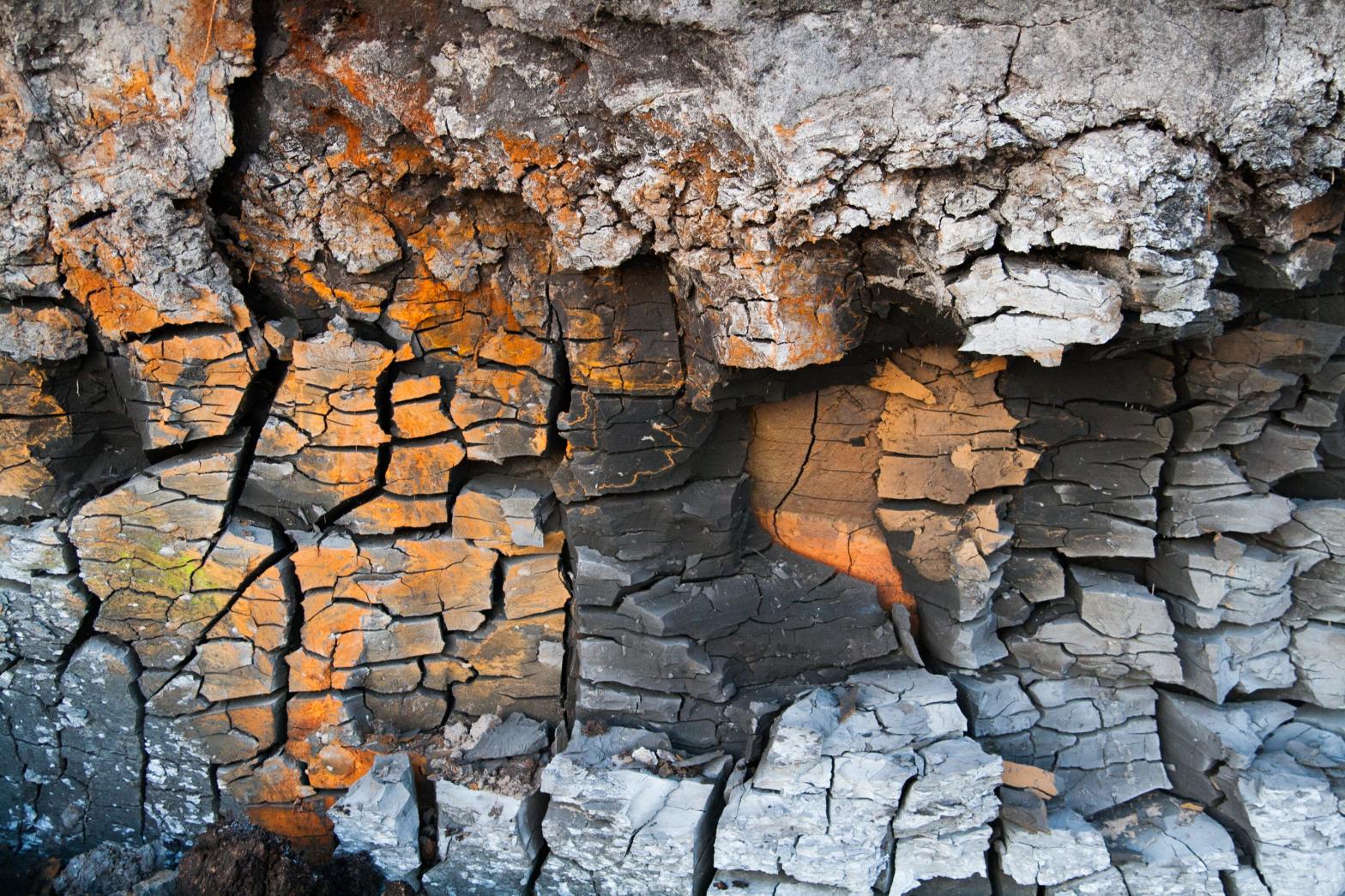
I have this nightmare in which I stand in the middle of an enormous continent, dry and barren, while cracks fissile out around me. Movement begins along these cracks, the land is carried away. All my people are carried away. I scream and scream.
Who would ever want to be the last one standing? To become the only human sound? Sprinkling dirt with the last human tears?
The Earth’s crust is traced with cracks. In geology, we call them fault lines. I learn about geology during my freshman year of college, sitting next to a boy who will become my first love. Even in September, I can feel it: the stirring. The beginning of something new and historic. Like the Earth, I guess. Its creation and recreation.
Earth is 4.543 billion years old. No one here will see that age change, which comforts me. Because even if “the end of the world” were to transpire, it wouldn’t be the end, not really. Earth will keep getting older, after our world ends.
Earth formed when heavy elements collided and their gravity pulled in swirling gas and dust. The dust will linger long after we take our last breath of it. It will fill our footprints and cover our cities. Earth’s dust is fundamental without reason. Like love, I guess.
Except, I don’t know if love can exist without lovers.
The boy and I both dread GEO141. But we sit together in the front row of our lecture hall. We are alone up there, and it occurs to me that we are acting very young. The seniors in the back probably scoff at our attentiveness.
He uses old-fashion pencils, the yellow kind that need sharpening. And there’s a small birthmark on his hand, between his thumb and pointer finger.
I am very focused on what my eyes are doing. They look straight ahead. My face appears focused. Sometimes, I am so good at appearing attentive that I forget to hear what the professor says.
The first time I let my eyes slide over to the boy’s notes, we are learning about the moon’s formation. Which, according to giant-impact theory, occurred when Earth collided with another planet. The collision was so massive that debris from Earth’s crust and mantle spewed into orbit, accreting to form the moon. The moon still pulls at Earth’s oceans. It likes to remind us of where it once came.
After the human apocalypse, the moon will finally reclaim its brightness. I imagine that moths, having no artificial lights toward which to fly, will turn back toward the glowing orb. They must miss it terribly.
For our first exam, I memorize the geological time scale, with all its iterations of “zoic.” Some periods are more important to remember than others, like the Cambrian Period, a time of rapid life expansion. Organisms were quickly diversifying and growing more complex. I wonder what the air sounded like, with all those new creatures breathing it. Earth only got louder when the dinosaurs arrived.
Dinosaurs lived on Earth for about 165 million years, which is an unqualified success in the history of life. We don’t talk about dinosaurs in class, though, probably because they make humans look bad.
I don’t talk about the exam either, because he scored half a point higher.
Another important point on the geological time scale is the most recent glaciation period, often known as the Ice Age. The Ice Age reached peak conditions some 18,000 years ago, forming the glaciers of today. We learn about glaciers in October: they form as snow is compressed over many centuries, creating massive bodies of ice.
Glaciers seem like they will last forever, but they don’t. Today, they’re disappearing at an accelerated rate. When the professor talks about climate change, he calls it our “daily dose of guilt.” He smiles apologetically and shrugs his shoulders. I feel exhaustion slip inside me.
I don’t understand how ice and love are on their way out, while Earth’s dust gets to last an eternity longer.
We don’t talk about fossil fuels in class, but we do, extensively, about three types of rock: igneous, sedimentary, and metamorphic. “Different rocks form under only certain conditions, which can tell us something important about the past,” the professor says.
Igneous rocks are formed deep within the earth, in a place melty and forbidden. I wonder if they like being pushed to the surface, or if they miss the warmth below. Metamorphic are formed from other rocks that are changed by heat and pressure. Sedimentary are formed from layers of sand, silt, and dead plants. How this layering process is consistent enough to create the same rocks, I have no idea.
Which type are you? I want to ask the boy. But it is 9AM, and he is still sipping coffee from a paper cup. Instead, I ask my question about sedimentary rocks. And forget to hear the answer.
I score higher than him on our second exam. Not by much, though. Now we can pretend to have a rivalry.
As the semester comes to a close, we focus on plate tectonics: the movement of the large plates of rock on the planet’s surface. Mantle flowing beneath Earth’s crust causes plates to shift, which in turn, changes the landscape.
The surface of the Earth is like a cracked eggshell. Which is a terrifying simile. I sit in class and try to ignore the truth of magma below.
Our professor draws diagrams on the board, composed of rectangles and arrows. Collisions and friction gave rise to mountains and volcanoes, he explains; “What happens when the plates slip?”
“Earthquake,” we recite in monotone voices. Most earthquakes are too small to be felt or cause damage. Large earthquakes are less common but can cause significant harm to the things we count on in everyday life. They change everything. They are world-ending.
“Who has experienced an earthquake?” he asks us.
I don’t raise my hand. But my heart is racing. I want to tell the boy that I’ve never been kissed before.
The Earth’s crust is traced with cracks. In geology, we call them fault lines. Along these fault lines, rocks slide up, down, or past each other. The movement is usually gradual and impossible to detect. Until something slips.
Please, I whisper to them, don’t slip. I’m not ready for my world to change.
Instead, I think about other inevitable things. Like how he will ask to study together for the final. And how I will stay up that night, hoping the apocalypse waits for me to fall, at least once.

 Quiet Histories