My best friend and I were having a drink in his room last night, when said he had a surprise for me. I smiled and asked to see it. He pointed under his bed.
His bed is really two beds, pushed parallel to the wall. A blanket falls over the mattress’s long side, hanging inches from the floor. I pulled the blanket up to peak beneath it. All I could see were his cardboard storage boxes, and darkness.
“What is this?” I asked. “Narnia?”
“Maybe,” he said. “Go see.” He pointed to a narrow gap between the boxes. Dropping to my hands and knees, I looked under the bed again. Through that tunnel of darkness, I could now make out a soft glow. And I began to crawl through, flattening my body and dragging myself along with my elbows.
The fort’s gray shag carpet was a welcome refugee for my elbows. Once inside, I felt suddenly alone. Blankets cascaded down as curtains, swaddling me in semi-darkness. Fairy-lights were strung up and down the back wall, tracing a mountain range of three-foot peaks. Their blue pricks of light splashed shadows everywhere. A tapestry hung above my hunched neck, buffering the bed’s ribcage.
It was cramped and it was wonderful. I marveled at the boy’s ingenuity.
“It’s a safe place,” he shrugged, after crawling in after me. Funny, how we seek refuge from our own rooms.
In the fort, the boy and I lay down on our backs, knees bent in front of us. Music floated down from above––we had left the speaker on his bed––and it sounded distant, as if we really had traveled far away.
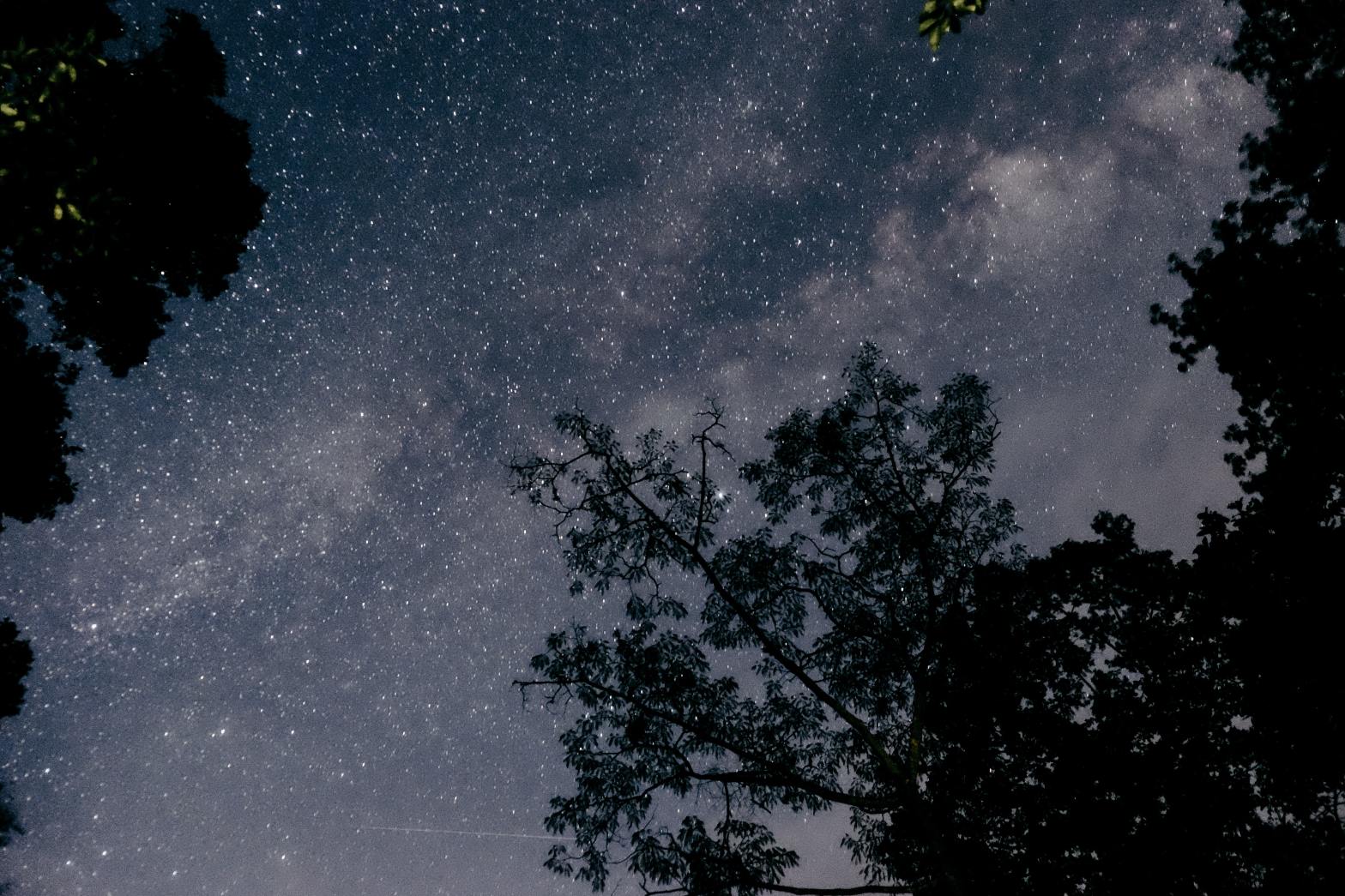
For most of the night, I gazed at the tapestry hanging above our heads. A starry sky was painted into the fabric, constellations framed by the dark silhouettes of treetops. It was easy to pretend this was our real view––as if we were really out in the natural world, peering up through the flaps of a tent. I could practically hear wind murmuring through the branches above. I could taste the cold air on my lips. I could smell the breath of our dying fire. I could feel the awe unfolding in my chest, an appreciation for bigger things.
Laying under those stars, he and I discussed apocalypses. Not the global pandemic. The apocalypse we imagine is more visceral than a virus: it involves running out into the world, not retreating from it. Our imagined disaster pushes us into the forest, where we must live in the moment, our eyes glued to the horizon, our ears tuned to the arrival of a faceless enemy. I think we long for a test that is raw and unmediated, to feel the harshness of the wild, the clarity of eating and killing and growing stronger. We wonder about our survival skills, our grit, our humanity. Most of all, we’re curious about our relationships: Who would live; who would die. Who would die for the others to live.
Would you die for me?
Yes, of course.
But in reality, we probably wouldn’t be given the choice. When it comes to mortality, there is no bargaining. If I could trade my life for someone else’s, I would have died twice already.
By the end of the night, conversation drifted to our respective childhoods. The bits of us that exist only through retellings. “What was the hardest part?” I asked him. “About growing up.”
“Moving,” he said. “Like, the actual packing and unpacking. My sister and I had to do it so many times, starting so young. Putting things in boxes and wrapping cups, and plates, and stuff––” he drifted off.
I imagined a young boy sitting cross-legged on the floor, folding kitchenware into newspaper. Carefully preparing items for another journey. With each move, he’d transfer his house into a dozen cardboard boxes.
In an apocalypse, his strength would be adaptability.
While the worst part of his childhood was moving, mine was the stillness. The year when nothing moved. For eight months, life was reduced to a ghostly desert tundra. I was in a snow globe, shaken up and then placed on a shelf. He knows about this year, but few people do. The sickness was a secret, after all. And I was in eighth grade, hardly a child. I wonder what he imagines I looked like back then. I’m glad he never had to see it.
In an apocalypse, my strength would be resilience.
Emerging from the fort felt like falling out of a wonderful dream: Disappointing. A sour taste returned to my mouth, left from the beer I drank before we went under. Saying goodnight to my friend, I left his dorm room and headed home.
I’d hoped the night air would be refreshing, but it was merely damp and forlorn. There was nothing inviting about it. I hugged myself as I walked, already wishing I were somewhere else: in the realm of fairy-lights and starry tapestry and shag carpet. In the place where apocalypses are fictional and we are the main characters, giving our lives for one another.

 Quiet Histories